GEOTECHNICAL ENGINEERING
MINNEAPOLIS
HomeInvestigationCPT (Cone Penetration Test)

Cone Penetration Testing (CPT) in Minneapolis: Fast Stratigraphy for Glacial Soils

Evidence-based design. Reliable delivery.

LEARN MORE

Minneapolis sits on a patchwork of glacial deposits, and that changes everything when you're planning a foundation. The city's geology ranges from dense, overconsolidated Superior Lobe till in neighborhoods like Linden Hills to looser outwash sands and silts near the Mississippi River floodplain. A standard boring and split-spoon sample only gives you a point every five feet, and in layered ground you can easily miss a thin, soft seam that controls settlement. The Cone Penetration Test (CPT) reads the soil column continuously, measuring tip resistance and sleeve friction inch by inch as the cone advances. For sites within Minneapolis—especially those near the river bluffs where Holocene alluvium overlies the St. Peter Sandstone—this continuous profile often catches compressible lenses that traditional sampling would skip. Our team runs the CPT rig with an integrated piezocone to track excess pore pressure dissipation, which matters when you're calculating consolidation time for a mat foundation on a tight urban lot in the North Loop.

A single CPT sounding replaces multiple SPT borings for stratigraphic profiling, and the data comes in before the rig leaves the site.
Our service areas

Methodology and scope

The contrast between two project zones we worked on last year tells the story best. One site was in Northeast Minneapolis, where the Des Moines Lobe dropped a stiff, clay-rich till that reads high cone resistance—typically 30 to 60 tsf—and you can design shallow footings with confidence. The other was a warehouse expansion six miles south, near the Minnesota River, where the CPT profile showed 15 feet of very loose fine sand with a friction ratio below 1%, followed by a sharp jump into dense glacial outwash. That loose sand layer, absent in a neighboring boring log from the 1980s, would have been missed entirely without the continuous CPT trace. The data pushed the structural engineer to switch from spread footings to driven piles, saving the owner a future differential settlement headache. For deep foundation design in the Twin Cities, we routinely pair the CPT with liquefaction analysis when the profile identifies saturated, loose sands below the water table—a common scenario along the river corridors where the post-glacial St. Anthony Falls retreat left complex depositional sequences.
Cone Penetration Testing (CPT) in Minneapolis: Fast Stratigraphy for Glacial Soils
Technical reference — Minneapolis

Local considerations

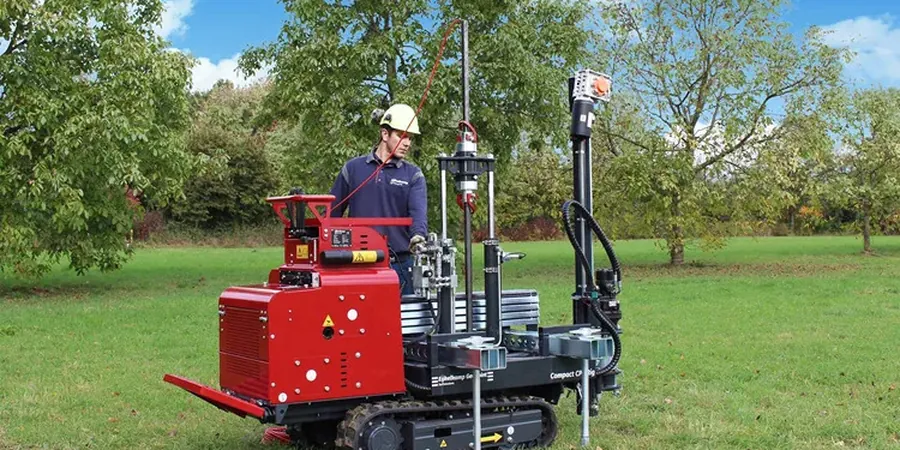
The rig we bring into Minneapolis is a 20-ton truck-mounted CPT system with hydraulic rams that push the cone rod at a constant 2 centimeters per second. In the dense Superior Lobe till that underlies much of the city, the push can hit refusal at 60 to 80 feet, which is deeper than most commercial projects need anyway. The real risk isn't the machine—it's what happens when a contractor skips the CPT and relies on limited SPT data in areas where the glacial stratigraphy changes over just a few hundred feet. We've seen projects near the Chain of Lakes where a buried peat lens, invisible on a boring log with 5-foot intervals, caused a floor slab to crack within two years. The cone picks up that organic layer immediately because the tip resistance drops and the friction ratio spikes. For sites in the downtown core, where excavation shoring is part of the scope, we cross-reference the CPT pore pressure data with our deep excavation monitoring protocol to anticipate dewatering demands before the shoring contractor mobilizes.

Need a geotechnical assessment?

Reply within 24h.

Email: contact@geotechnicalengineering1.org

Applicable standards

ASTM D5778-20 (Electronic Friction Cone and Piezocone Penetration Testing), Minnesota Building Code (2020, IBC-based) Chapter 18, AASHTO T-306 (CPT for transportation projects), ASCE 7-22 Section 20 (Site Classification via CPT)

Technical parameters

ParameterTypical value
Cone type10 cm² piezocone (u₂ transducer)
Penetration rate2 cm/sec per ASTM D5778-20
Measured parametersqc (tip resistance), fs (sleeve friction), u₂ (pore pressure)
Correlations availableN₆₀ equivalent, undrained shear strength (Su), OCR, M (constrained modulus)
Push capacity (typical)20-ton truck-mounted rig, sufficient for dense glacial till
Data reductionSoil Behavior Type (SBT) chart, Robertson 1986/2010 method
ReportingContinuous logs with SBT classification, qc, fs, Rf, u₂, and N₆₀ equivalent

Frequently asked questions

What depth can you reach in Minneapolis glacial till?

Our 20-ton CPT rig typically reaches 60 to 80 feet in the dense Superior Lobe till that underlies much of Minneapolis. Refusal occurs when the cone encounters very dense till or cobble-rich zones at the base of the glacial sequence. For most commercial and residential projects in the metro, this depth range exceeds what's needed for foundation design.

How much does a CPT sounding cost in the Twin Cities?

A standard CPTu sounding in Minneapolis runs between US$180 and US$230 per test, depending on depth, traffic control requirements, and whether dissipation tests are included. A typical commercial site with three to five soundings can usually be completed in a single day.

Can CPT replace soil borings for a Minneapolis building permit?

In many cases, yes—the Minnesota Building Code accepts CPT data for subsurface investigation when correlated to local soil behavior types. However, most projects still require at least one soil boring for sample recovery and lab testing. We coordinate the CPT with a companion boring program to meet the permit reviewer's requirements while maximizing the stratigraphic detail from the cone.

Location and service area

We serve projects across Minneapolis and its metropolitan area.

View larger map