GEOTECHNICAL ENGINEERING
MINNEAPOLIS
HomeLaboratoryGrain size analysis (sieve + hydrometer)

Grain Size Analysis (Sieve + Hydrometer) for Minneapolis Construction Projects

Evidence-based design. Reliable delivery.

LEARN MORE

With nearly 4% of Minneapolis land area sitting on artificial fill from the city's milling and river-industry past, assuming uniform soil is a gamble that has delayed more than one foundation pour in the North Loop. The grain size analysis—combining mechanical sieves for the coarse fraction and a hydrometer for the fines—maps the exact distribution from gravel down to clay colloids. For a city where glacial Lake Agassiz outwash sands meet silty Mississippi River terraces, that distribution dictates everything from frost-heave susceptibility to drainage design under the IBC. We run the test in our accredited lab following ASTM D6913 and D422, and the report becomes the common language your geotechnical engineer and the City of Minneapolis plan reviewer both need.

A 2% difference in fines content can change the frost classification from S1 to F3 under Minnesota DOT specs—and that changes the entire subgrade design.
Our service areas

Methodology and scope

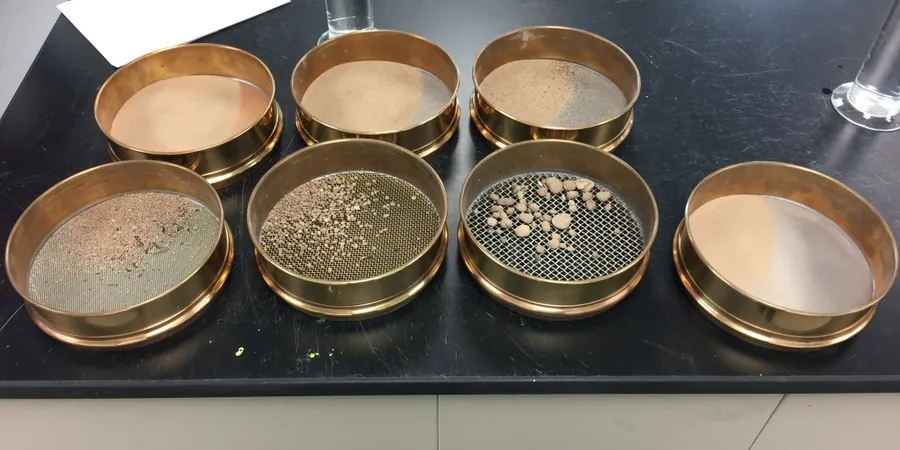
The Des Moines lobe deposited a blanket of calcareous till across Hennepin County, but the Mississippi carved through it and left terraces of well-rounded sand and gravel that can fool a visual classification. Sieve stacks separate that material into retained percentages on each mesh, while the hydrometer settles out the silt and clay that control cohesion. When the hydrometer reading stays suspended after 24 hours, you are dealing with active clay minerals that swell with the spring thaw—a reality for sites near the Chain of Lakes where the water table rises seasonally. For projects requiring a complete picture of the soil behavior, the grain size data pairs well with an atterberg limits determination to confirm plasticity, or with a proctor tests series to set the compaction target for fill lifts. The combined dataset tells you whether that brown silty sand is a well-graded SW-SM or a gap-graded SP with a fines content that will pump water.
Grain Size Analysis (Sieve + Hydrometer) for Minneapolis Construction Projects
Technical reference — Minneapolis

Local considerations

Compare a site in the Bryn Mawr neighborhood near Bassett Creek with one over in the Seward triangle east of Hiawatha Avenue. Bryn Mawr gives you sandy outwash that drains fast and compacts easily—a grain size curve that will show maybe 8% passing the #200 sieve. Seward, sitting on Mississippi floodplain deposits, delivers a silty lean clay where the hydrometer reveals 60% fines and the D10 is below 0.01 mm. The first site handles a standard footing with minimal prep; the second requires over-excavation, granular fill, and a drainage plan that adds six figures to the budget if not caught early. The sieve-hydrometer combination catches that difference before the excavator arrives, giving you a defensible basis for the geotechnical recommendation and keeping the project out of the kind of change-order spiral that plagues Minneapolis infill work.

Need a geotechnical assessment?

Reply within 24h.

Email: contact@geotechnicalengineering1.org

Applicable standards

ASTM D6913-17, ASTM D422-63(2007) reapproved, ASTM C117-17, AASHTO T 311-00, AASHTO T 88-19, MnDOT 2105 gradation specifications

Technical parameters

ParameterTypical value
Test standard (coarse)ASTM D6913 / AASHTO T 311
Test standard (fine)ASTM D422 / AASHTO T 88
Sieve range75 mm (3") to 75 µm (No. 200)
Hydrometer type152H, calibrated for 20°C
Minimum sample mass500 g (fine), 5 kg (coarse)
Coefficients reportedCu, Cc, D10, D30, D60, % gravel/sand/fines
Frost classificationPer MnDOT 2105 / USACE criteria
Wash loss procedureASTM C117 (material finer than 75 µm)

Frequently asked questions

How much does a grain size analysis cost for a typical Minneapolis residential lot?

For a standard combined sieve and hydrometer test on a single sample, the fee normally runs between US$100 and US$190 depending on the number of sieves requested and whether the hydrometer is included. Commercial projects with multiple samples or rush turnaround may sit at the upper end of that range.

What is the difference between a wash sieve and a dry sieve analysis?

A dry sieve shakes the soil as-is, but fine silt and clay cling to the larger particles and never reach the pan. A wash sieve runs water through the stack to detach those fines, giving a true measure of material passing the No. 200 sieve. For any Minneapolis soil with visible fines—which is most of them—the wash method per ASTM C117 is mandatory if the gradation curve is to be used for drainage or frost design.

How does the hydrometer part of the test actually work?

We mix about 50 grams of minus-No. 200 material with a sodium hexametaphosphate dispersant and distilled water in a sedimentation cylinder. A 152H hydrometer is lowered into the suspension at timed intervals—2, 5, 15, 30, 60, 250, and 1440 minutes—and the readings, corrected for temperature and meniscus, are converted to particle diameters via Stokes' law. The result is the silt and clay distribution that defines the fine end of the gradation curve.

Location and service area

We serve projects across Minneapolis and its metropolitan area. More info.

View larger map