GEOTECHNICAL ENGINEERING
MINNEAPOLIS
HomeSeismicSoil liquefaction analysis

Soil Liquefaction Analysis for Seismically Active Zones in Minneapolis

Evidence-based design. Reliable delivery.

LEARN MORE

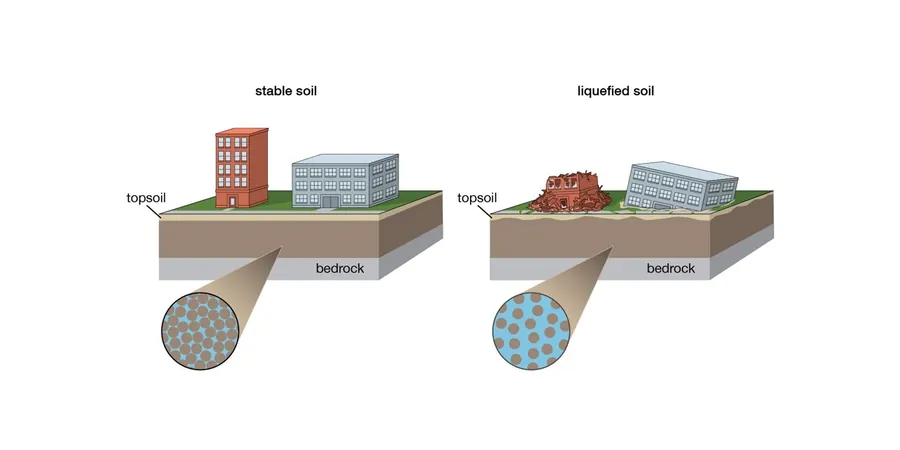
The Mississippi River valley didn't just shape Minneapolis — it left behind a layer of loose alluvial and outwash sands that can liquefy under the right seismic load. Even a moderate event on the Midcontinent Rift could trigger cyclic mobility in saturated deposits near the Chain of Lakes or downstream toward St. Paul. We run ASTM D1586 standard penetration tests and combine them with grain-size distribution per ASTM D2487 to quantify the factor of safety against liquefaction. For sites with deep lacustrine clay interbeds, we often pair the analysis with CPT testing to capture continuous soil behavior index profiles, and sometimes integrate MASW surveys to refine Vs profiles when NEHRP site class boundaries need confirmation.

Liquefaction isn't just a West Coast problem. The glacial outwash under Minneapolis can lose strength fast if pore pressures spike during a seismic event.
Our service areas

Methodology and scope

On the ground here, we see that many pre-1950s mill district fills can hide loose hydraulic sands that lab classification alone misses. That's why our approach always links field penetration resistance with fines content. We run sieve and hydrometer tests on disturbed samples from SPT splits, then apply the Youd-Idriss (2001) NCEER framework to correct N-values for overburden, energy ratio, and fines. Liquefaction potential index (LPI) maps are generated for each borehole so the structural engineer can decide on ground improvement or deep foundation alternatives. When preliminary screening flags borderline soils, we recommend triaxial testing to measure cyclic resistance ratio directly on reconstituted specimens, which gives a much tighter uncertainty band than SPT-based correlations alone.
Soil Liquefaction Analysis for Seismically Active Zones in Minneapolis
Technical reference — Minneapolis

Local considerations

Minneapolis grew fast along the river, packing mills, grain elevators, and later highway interchanges onto ground that had never been evaluated for seismic performance. The 1863 mill explosion and subsequent reconstruction cycles left pockets of fill with variable density. Today, I-35W and the light-rail corridors cross areas where saturated silty sand at 15 to 25 feet could undergo settlement and lateral spread even under a 500-year return period motion. A geotechnical report without site-specific liquefaction analysis is a liability — building codes under IBC Chapter 18 and ASCE 7 require it for Seismic Design Category C and above, which covers most of Hennepin County.

Need a geotechnical assessment?

Reply within 24h.

Email: contact@geotechnicalengineering1.org

Applicable standards

ASTM D1586-18: Standard Test Method for Standard Penetration Test (SPT) and Split-Barrel Sampling of Soils, ASTM D2487-17: Standard Practice for Classification of Soils for Engineering Purposes (Unified Soil Classification System), NCEER Workshop (Youd & Idriss, 2001): Liquefaction Resistance of Soils – Summary Report, ASCE/SEI 7-22: Minimum Design Loads and Associated Criteria for Buildings and Other Structures, IBC 2021: International Building Code, Chapter 18 – Soils and Foundations

Technical parameters

ParameterTypical value
SPT N-value (N60)1–50 blows/ft, energy-corrected per ASTM D1586
Fines content% passing #200 sieve per ASTM D1140 / D2487
Cyclic Stress Ratio (CSR)Seed-Idriss simplified procedure, Mw-adjusted
Cyclic Resistance Ratio (CRR)NCEER workshop (Youd et al. 2001), fines-corrected
Factor of Safety (FS)CRR/CSR, minimum threshold typically 1.1–1.3
Liquefaction Potential Index (LPI)Integrated over depth, 0–30 m
Shear wave velocity (Vs)From MASW or SCPT, used for site class per ASCE 7
Groundwater depthMeasured in standpipe or piezometer at time of investigation

Frequently asked questions

How much does a soil liquefaction analysis cost for a typical Minneapolis site?

For a single-family or small commercial lot, the field and lab program usually runs between US$2,750 and US$3,620. The final number depends on the number of boreholes, depth to refusal, and whether we need additional CPT or geophysical testing.

Which Minneapolis neighborhoods are most susceptible to liquefaction?

Areas with shallow groundwater and Holocene alluvium along the Mississippi River corridor — parts of Northeast, Downtown East near the old milling district, and low terraces in the Longfellow and Prospect Park neighborhoods — tend to show the highest liquefaction potential indices in our screening studies.

Do you run the analysis for both SPT and CPT data?

Yes. We apply the NCEER/Youd-Idriss framework for SPT data and the Robertson (2009) or Boulanger-Idriss (2014) methods for CPT data. The choice depends on site access and the stratigraphy we expect from the desk study.

What seismic parameters do you use for Minneapolis?

We pull the mapped spectral accelerations Ss and S1 from the USGS Unified Hazard Tool for the site coordinates, then adjust them for site class per ASCE 7-22 Chapter 11. For critical projects, we may run a site-specific probabilistic seismic hazard analysis (PSHA) rather than using the code defaults.

Location and service area

We serve projects across Minneapolis and its metropolitan area.

View larger map