GEOTECHNICAL ENGINEERING
MINNEAPOLIS
HomeGround improvementVibrocompaction design

Vibrocompaction Design for Deep Soil Improvement in Minneapolis

Evidence-based design. Reliable delivery.

LEARN MORE

A recent warehouse expansion near the Mississippi River in Minneapolis encountered 15 feet of loose alluvial sand beneath the planned slab-on-grade. The site straddles an old river terrace, where natural deposition left a soil matrix with relative density below 40 percent — a profile that would settle differentially under the articulated rack systems common in logistics centers. Our team developed a vibrocompaction design that specified a triangular grid at 8-foot spacing, using variable frequency to reach target SPT N-values above 20 throughout the treatment zone. The approach eliminated the need for deep foundations, saving the developer roughly three months against a driven-pile alternative. Minneapolis sits on a complex glacial and alluvial substrate drained by the Mississippi gorge, and deep granular deposits with low N-values are more common than many project owners realize. When we coordinate the compaction program with pre- and post-treatment in-situ permeability testing, the verification data gives the structural engineer confidence to proceed with shallow footings on improved ground.

Effective vibrocompaction design in Minneapolis converts SPT N-values from single digits to above 20, eliminating the need for deep foundations on granular sites.
Our service areas

Methodology and scope

The glacial history of the Twin Cities left behind thick outwash sequences that dominate the subsurface from downtown Minneapolis to the northern suburbs. These deposits — primarily medium to fine sands with intermittent silt lenses — often exhibit corrected SPT N-values between 6 and 14 at depths of 10 to 30 feet, a range that triggers settlement and liquefaction concerns under IBC Chapter 18 and the Minnesota State Building Code. Vibrocompaction design in this region must account for the groundwater table, which sits unusually high at 8 to 12 feet below grade in many Minneapolis neighborhoods due to the proximity of the Mississippi River and the chain of lakes. A proper design sequence starts with a site-specific response spectrum per ASCE 7-22, maps the target relative density (typically 70 to 85 percent), and then selects vibroflot spacing, amperage, and dwell time to achieve that density across the full treatment depth. The design also integrates CPT correlations — particularly the Robertson 2009 method — to convert cone tip resistance into a densification specification that the specialty contractor can execute.
  • Triangular grid layouts optimized for clean sands with fines content below 15 percent
  • Frequency modulation between 30 and 60 Hz to match the grain-size distribution from sieve analysis
  • Settlement verification using Schmertmann's method on post-treatment CPT data
  • Liquefaction triggering analysis per Boulanger & Idriss (2014) with post-compaction SPT blow counts
Vibrocompaction Design for Deep Soil Improvement in Minneapolis
Technical reference — Minneapolis

Local considerations

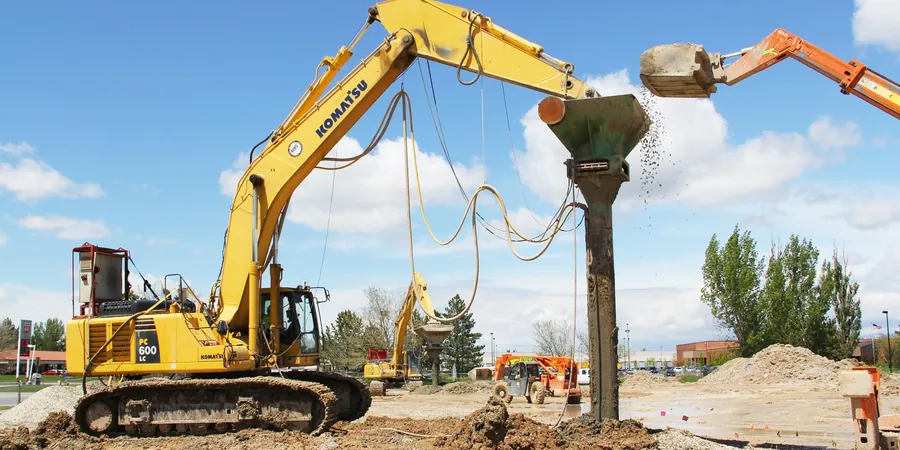
The vibroflot assembly — a 15-foot-long cylindrical probe with internal eccentric weights driven by a 100 to 200 HP electric or hydraulic motor — descends under its own mass plus water jetting through the loose granular column. In Minneapolis, where the water table often stabilizes just 8 feet down, the saturation condition aids the liquefaction-phase insertion but demands careful control of the water flow rate to prevent piping fines toward the surface and creating a diluted, low-strength crust. The primary performance risk we see in the field is under-compaction of thinly interbedded silt seams: the vibratory energy propagates well through clean sand but attenuates abruptly at silt lenses, leaving untreated pockets that can compress later under load. We mitigate this by specifying dwell-time extensions and secondary passes at the silt horizons identified in the pre-design boring logs. Another risk is over-compaction near existing utilities — the ground vibration transmits up to 50 feet away, and without a pre-condition survey, adjacent sanitary sewers or district heating pipes (common in older Minneapolis neighborhoods) can suffer joint displacement.

Need a geotechnical assessment?

Reply within 24h.

Email: contact@geotechnicalengineering1.org

Applicable standards

ASTM D1586-18 (Standard Test Method for SPT), ASCE 7-22 (Minimum Design Loads — Seismic), IBC Chapter 18 (Soils and Foundations), ASTM D4253/D4254 (Maximum Index Density of Soils), Boulanger & Idriss (2014) CPT and SPT Based Liquefaction Triggering Procedures

Technical parameters

ParameterTypical value
Target relative density70–85% (ASTM D4253/D4254)
Typical treatment depth15–60 ft below grade
Vibroflot spacing range6–12 ft triangular grid
Applicable soil typeClean to silty sands (fines <15%)
Post-treatment verificationCPT, SPT, or PMT at 10% of points
Liquefaction analysis standardBoulanger & Idriss (2014), NCEER
Groundwater correctionOverburden and energy correction per ASTM D1586

Frequently asked questions

What soil conditions in Minneapolis are best suited for vibrocompaction?

The technique works best in clean to slightly silty sands with fines content below 15 percent — precisely the alluvial and glacial outwash deposits found along the Mississippi River corridor and across much of south Minneapolis. Silty sands with 15 to 25 percent fines can still be treated, but the vibroflot spacing must tighten to 5–7 feet, and dwell time per lift increases. Clay seams thicker than 12 inches defeat the compaction energy, so we recommend a pre-design boring program to map the stratigraphy before committing to vibrocompaction.

How do you verify that the ground has been adequately densified?

Verification follows a two-phase protocol. During compaction, the vibroflot operator records amperage draw and penetration rate continuously — an amperage plateau at the target value signals that the sand has reached refusal density for that energy level. After treatment, we run CPT soundings at 10 percent of grid points (never fewer than three per site) and compare the post-treatment cone tip resistance to the design threshold derived from the liquefaction analysis. A site passes when 90 percent of verification points exceed the target qc.

What does vibrocompaction design cost for a typical Minneapolis commercial project?

For a mid-size commercial footprint — think a 20,000-square-foot building pad — the vibrocompaction design package, including pre-treatment borings, energy modeling, on-site quality assurance during compaction, and post-treatment CPT verification, typically falls between US$1,350 and US$4,600 depending on the treatment depth and the number of verification points required. The specialty contractor's mobilization and compaction work is a separate line item.

Can vibrocompaction be used near existing structures in Minneapolis?

Yes, but with vibration monitoring as a mandatory part of the design. We specify a pre-condition survey of all structures within a 50-foot radius of the outermost compaction point, install triaxial geophones on adjacent foundations, and set peak-particle-velocity thresholds (typically 0.5 in/sec for unreinforced masonry common in older Minneapolis buildings). If vibration exceeds the limit, we adjust vibroflot frequency or switch to a pre-augered insertion method that reduces lateral energy transmission.

Location and service area

We serve projects across Minneapolis and its metropolitan area.

View larger map