GEOTECHNICAL ENGINEERING
MINNEAPOLIS
HomeIn-Situ TestingField density test (sand cone method)

Field Density Testing in Minneapolis: Sand Cone Method for Compaction Control

Evidence-based design. Reliable delivery.

LEARN MORE

Minneapolis grew from a milling powerhouse at St. Anthony Falls into a modern metro built on challenging glacial terrain. The city's subsurface is dominated by dense glacial till, interspersed with layers of lacustrine clay and silty sand deposited by Lake Agassiz outburst floods roughly 9,000 years ago. Those who manage earthwork here know that achieving uniform compaction on these variable soils requires more than a single pass with a smooth-drum roller. Laboratory Proctor values are only half the story—without reliable field verification, even well-graded fill can settle differentially under Minnesota's brutal freeze-thaw cycles. Our team uses the sand cone density test in accordance with ASTM D1556 to measure in-place density directly on active construction sites, from the North Loop to the University Avenue corridor, ensuring the compacted layer meets the project's structural requirements before the next lift goes down.

A 98 percent relative compaction reading means nothing if the reference Proctor was run on a different soil type. We match the field test to the exact borrow source every time.
Our service areas

Methodology and scope

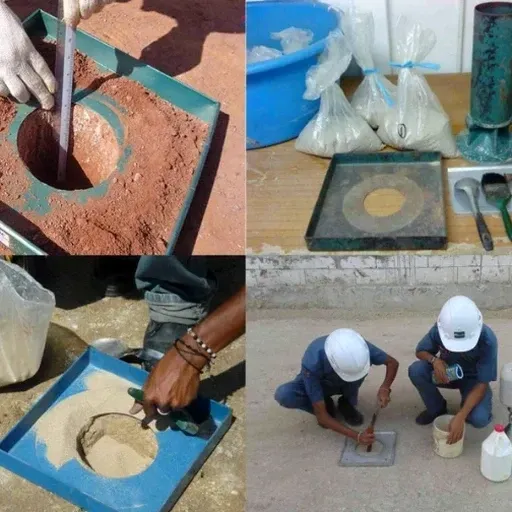
A persistent mistake on Minneapolis projects is running the nuclear gauge over freshly rolled fill that contains cobbles or frozen lumps—two realities of local excavation from October through April. The gauge reads a smooth average but completely misses voids around larger particles, which is where most post-construction settlement initiates. The sand cone method, while slower, physically displaces a measured volume of calibrated Ottawa sand into the test hole, catching those irregularities that electronic devices overlook. We often combine this with a Proctor test to establish the maximum dry density reference curve for the specific borrow source on site. The procedure requires careful attention to moisture content—Minneapolis fat clays can hold water at 18 to 24 percent optimum, and a deviation of just two points can drop relative compaction below the 95 percent standard specified by MnDOT. Our technicians run rapid moisture determinations using a Speedy meter or microwave oven on every third test to adjust compaction effort in real time.
Field Density Testing in Minneapolis: Sand Cone Method for Compaction Control
Technical reference — Minneapolis

Local considerations

The Mississippi River valley and its tributary creeks have deposited up to 40 feet of compressible alluvium in parts of downtown and Northeast Minneapolis. When fill is placed over these soft zones without verified density, differential settlement can pull apart slab-on-grade floors and rack steel frames within the first two winters. Rising groundwater during spring melt—common in Hennepin County when the frost line retreats from its typical 60-inch depth—saturates poorly compacted lift boundaries and triggers localized bearing failures. We have mapped post-construction problems on several warehouse expansions near the Minneapolis–St. Paul International Airport where organic silts beneath the fill were not addressed before paving. A thorough field density program tied to a fill placement specification reduces these risks by catching low-density pockets before the next lift buries them. For sites near the river bluffs, we recommend pairing density testing with a slope stability analysis if the fill buttresses an existing grade.

Need a geotechnical assessment?

Reply within 24h.

Email: contact@geotechnicalengineering1.org

Applicable standards

ASTM D1556-15e1: Standard Test Method for Density and Unit Weight of Soil in Place by Sand-Cone Method, AASHTO T-191: Density of Soil In-Place by the Sand-Cone Method, MnDOT Standard Specification 2105: Excavation and Embankment, ASTM D1557-12e1: Standard Test Methods for Laboratory Compaction Characteristics of Soil Using Modified Effort, IBC 2021 Chapter 18: Soils and Foundations

Technical parameters

ParameterTypical value
Test standardASTM D1556 / AASHTO T-191
Test hole diameter100 to 150 mm (4 to 6 in), depth equal to lift thickness
Calibrated sandASTM C778 graded Ottawa sand, bulk density verified daily
Typical test frequency1 test per 1,500–2,500 sq ft per lift (per MnDOT spec 2105)
Minimum relative compaction95% of modified Proctor (ASTM D1557) for structural fill
Moisture control range±2% of optimum moisture content
Applicable soil typesCohesive soils with max particle size < 75 mm, no frozen material
ReportingDry density, wet density, moisture content, relative compaction, pass/fail by lift

Frequently asked questions

When does MnDOT require a sand cone test instead of a nuclear density gauge?

MnDOT spec 2105 requires the sand cone method for referee testing when nuclear gauge results are disputed, and for all density tests on soils containing particles larger than 1.5 inches that would bias a nuclear reading. Additionally, many Minneapolis municipal projects on school sites or parkland mandate the sand cone method to avoid radiation permitting requirements.

How much does a field density test cost in Minneapolis?

A single sand cone density test with same-day moisture determination typically runs between US$110 and US$150, depending on the number of tests per mobilization and whether a Proctor reference curve already exists. Volume discounts apply for ongoing mass grading projects with daily testing requirements.

How many sand cone tests do I need per day of earthwork?

The standard rule under MnDOT spec is one test per 1,500 to 2,500 square feet per compacted lift. For a typical commercial building pad of 20,000 square feet with 8-inch lifts, that means 8 to 14 tests per lift. Critical areas like footing subgrades or utility trench backfill often require tighter spacing regardless of total area.

Can you run a sand cone test on frozen ground or fill containing ice lenses?

No. ASTM D1556 explicitly prohibits testing on frozen soil. Ice lenses will melt after compaction and leave void spaces that the sand cone cannot detect during the test. In Minneapolis winter conditions, the fill must be thawed and dried to a workable moisture content before placing and testing. We typically pause density testing when the ambient temperature drops below 25 degrees Fahrenheit for more than four consecutive hours.

Location and service area

We serve projects across Minneapolis and its metropolitan area.

View larger map