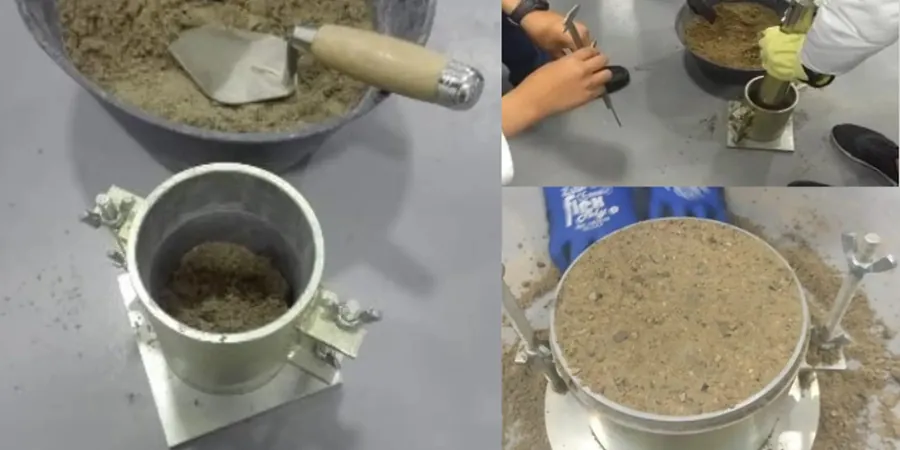
Moving from the dense glacial till of Northeast Minneapolis down toward the Mississippi river flats near Longfellow, you see a complete shift in the soil profile in less than a mile. The same thing happens crossing from the sandy ridges of Columbia Heights into the former marshland now occupied by South Minneapolis neighborhoods. That variability is exactly why a Proctor test is not a generic formality here. A Modified Proctor on a well-graded till can yield a maximum dry density above 130 pcf, while the silty Standard Proctor on a lacustrine terrace deposit might top out near 112 pcf. When we run a sand cone density check on compacted backfill, the reference has to match the same energy and material that the contractor actually placed. Without that site-specific curve, a 95 percent compaction spec means nothing.
A 1 percent shift in optimum moisture on a Minneapolis clay fill can mean the difference between passing density and a failed lift that brings the pipe crew to a halt.