GEOTECHNICAL ENGINEERING
MINNEAPOLIS
HomeInvestigationSPT (Standard Penetration Test)

SPT Testing in Minneapolis — Standard Penetration Test for Glacial Soils

Evidence-based design. Reliable delivery.

LEARN MORE

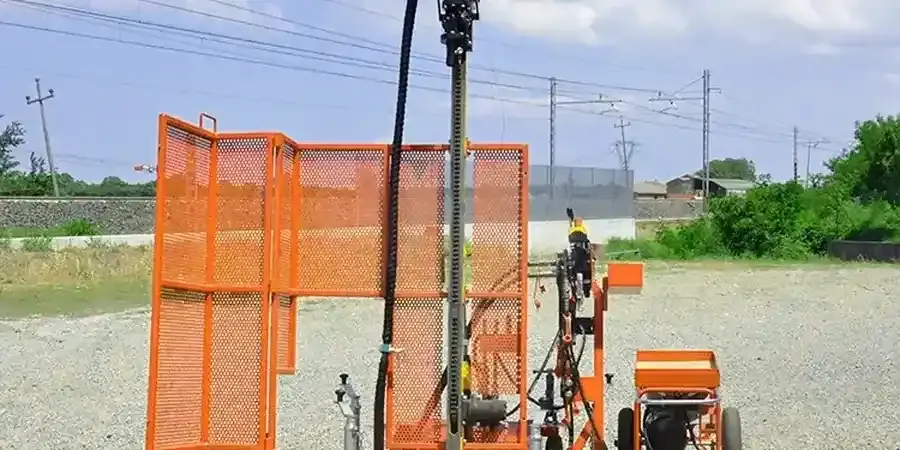
The CME-75 track-mounted drill rig is a common sight on Minneapolis job sites, its automatic hammer lifting and dropping a 140-pound weight precisely 30 inches onto the drill rods. Unlike southern states where refusal hits shallow limestone, operators around Hennepin County contend with the gray, over-consolidated Des Moines Lobe till — a dense, silty-clay matrix studded with erratic granite cobbles that can chew through split-spoon samplers in under two feet of advancement. The standard penetration test here rarely reaches the textbook 18-inch penetration per blow sequence without triggering early refusal past the 50-blow mark, which means the crew must log partial penetration values and flag the depth for coring. Before committing to a deep foundation scheme, many geotechnical engineers pair the SPT dataset with CPT soundings to fill resolution gaps in interbedded silt lenses, and when working near the Mississippi River bluffs, they cross-reference the blow counts with liquefaction trigger curves derived from Youd-Idriss 2001 methodology to satisfy the Minneapolis building code amendment for seismic site class determination.

Minneapolis glacial till pushes SPT refusal past 50 blows in under six inches — logging partial penetration becomes the norm, not the exception.
Our service areas

Methodology and scope

ASTM D1586-18 governs the hammer energy calibration and sampler dimensions, but the real value of the standard penetration test in Minneapolis comes from the decades of local correlations embedded in the University of Minnesota's geotechnical database. Because the city straddles multiple depositional environments — from the St. Francis till in the northern suburbs to the post-glacial Lake Agassiz clays near the river — a blow count of N=15 in northeast Minneapolis implies a markedly different friction angle and undrained shear strength than the same N-value recorded in the sandy outwash of Edina. The Minnesota Department of Transportation's LRFD bridge design manual ties allowable bearing pressure directly to SPT N-values corrected for overburden, hammer energy ratio, and rod length, requiring that each test interval include a torque reading on the rods to back-calculate skin friction for drilled shaft design. In broad floodplain zones where the water table sits within three feet of grade, the crew advances a mud rotary setup behind the split-spoon drive to keep the borehole open, and the retrieved samples undergo immediate visual classification per ASTM D2487 before being sealed for laboratory grain-size analysis and Atterberg limits testing.
SPT Testing in Minneapolis — Standard Penetration Test for Glacial Soils
Technical reference — Minneapolis

Local considerations

A 14-story mixed-use tower proposed near the intersection of Washington Avenue and Hennepin Avenue required SPT borings to 120 feet through the St. Peter sandstone contact. The upper 45 feet consisted of alluvial sands and silts deposited during the River Warren stage, with blow counts ranging from N=8 to N=14 — values that trigger mandatory liquefaction analysis under the Minnesota State Building Code's seismic provisions. The geotechnical consultant ran Seed-Idriss simplified procedure calculations using the corrected N1,60 values and found that the cyclic resistance ratio dropped below the seismic demand at depths between 18 and 32 feet, a layer corresponding to a loose, saturated fine sand unit mapped in the Minneapolis Quaternary geology atlas. Because the structural engineer had already locked the column grid, the foundation solution pivoted to a mat slab underlain by aggregate piers densified to a post-treatment N1,60 of 25, verified by six confirmation borings drilled between the production piers. The SPT refusal depth also confirmed that the sandstone bedrock surface dipped eight feet across the building footprint — enough to trigger differential settlement concerns that the structural team addressed with a variable-thickness mud slab.

Need a geotechnical assessment?

Reply within 24h.

Email: contact@geotechnicalengineering1.org

Applicable standards

ASTM D1586-18 — Standard Test Method for Standard Penetration Test (SPT) and Split-Barrel Sampling of Soils, ASTM D2487-17 — Standard Practice for Classification of Soils for Engineering Purposes (Unified Soil Classification System), Minnesota Department of Transportation LRFD Bridge Design Manual — Section 10: Foundation Design Using SPT Correlations

Technical parameters

ParameterTypical value
Hammer typeAutomatic trip (CME safety hammer), calibrated per ASTM D6066
SamplerStandard 2-inch OD split spoon, 18-inch drive length
Energy ratio (Er)60% nominal; measured via Pile Dynamics PDA for cathead rigs
Typical test interval5-foot vertical spacing, continuous in critical liquefiable layers
N60 correctionOverburden (CN), hammer energy (CE), rod length (CR), borehole diameter (CB)
Undisturbed sampling triggerShelby tube pushed at cohesive intervals per SPT refusal or N>40
Groundwater monitoringStandpipe piezometer installed in at least one borehole per site

Frequently asked questions

What does an SPT test cost on a typical Minneapolis commercial lot?

For a standard investigation with three to five boreholes advanced to 40–60 feet depth in the Twin Cities metro area, SPT testing typically runs between US$560 and US$690 per borehole, including the drill crew, automatic hammer rig mobilization, split-spoon sampling at 5-foot intervals, field logging, and a summary report with corrected N60 values. Sites requiring traffic control permits on Minneapolis arterial streets, mud rotary drilling through caving sand layers, or Shelby tube sampling in soft clays will push toward the upper end of that range due to the extra equipment and crew hours needed to maintain borehole stability.

How deep do SPT borings need to go for a mid-rise building in Minneapolis?

The Minnesota State Building Code requires borings to extend below the deepest planned foundation element by at least 20 feet, or until they encounter bedrock with an N-value exceeding 100 blows per foot for two consecutive intervals. For a typical 6- to 10-story structure on the glacial till that underlies much of downtown Minneapolis, this usually means 60 to 80 feet of SPT sampling, with a rock core taken at refusal to confirm the top of the St. Peter sandstone or the underlying Prairie du Chien dolomite. Taller towers near the Mississippi River bluffs often need 100 to 120 feet to capture the full soil column for the seismic site response model required by the city's building official.

Why do SPT blow counts vary so much across different Minneapolis neighborhoods?

Minneapolis sits on a patchwork of glacial deposits left by the retreat of the Des Moines Lobe roughly 12,000 years ago. The northeast and downtown areas are underlain by dense, over-consolidated till with N-values commonly exceeding 30, while the river-adjacent neighborhoods of Seward and Longfellow sit on looser alluvial sands and silts where blow counts between 8 and 15 are the norm. The Uptown and south Minneapolis corridors cross ancient Lake Agassiz shorelines, leaving thick sequences of soft, normally consolidated clay that can produce SPT N-values as low as 4 and require the drill crew to switch to Shelby tube sampling after the split spoon barely recovers a sample. This variability is exactly why geotechnical reports reference the specific Minneapolis Quaternary geology map unit when interpreting test results.

What is the difference between N-value and N60 in a Minneapolis SPT report?

The raw N-value recorded on the drill log is the number of hammer blows required to drive the split spoon sampler the final 12 inches of a standard 18-inch penetration. The N60 value adjusts that raw count to a standardized 60 percent hammer energy efficiency, because automatic trip hammers, safety hammers, and old cathead-and-rope rigs deliver different amounts of energy to the drill rods. In Minneapolis, where MnDOT and most structural engineers require N60 for foundation design, the correction also accounts for the overburden pressure at the test depth (which compacts the soil artificially), the rod length from the ground surface to the sampler, and the borehole diameter — a 4-inch casing hole versus an 8-inch auger hole changes the lateral confinement around the sampler and affects the blow count.

Location and service area

We serve projects across Minneapolis and its metropolitan area.

View larger map